




A Week in Toronto
Sue Austin, food production manager at Nottingham University Hospitals NHS trust reflects on her recent trip to Canada, sponsored by Burlodge.
When I learned that I had been drawn to represent the HCA on a healthcare catering study exchange visit to Toronto, Canada, I felt both honoured and excited. Opportunities to see healthcare foodservice beyond the NHS are rare, and the chance to learn from Canadian colleagues while sharing our own experiences from Nottingham University Hospitals was something I knew would be invaluable.
What followed was one of the most professionally organised, enjoyable and rewarding experiences of my career.
A Trip to Canada
The exchange was fully sponsored by Burlodge, and from the moment the arrangements began, every detail was considered. The programme was far more than an itinerary. It was a comprehensive guide covering every aspect of the journey from door to door, including travel arrangements, accommodation, local transport, site visits, restaurant recommendations and even consideration of my own food preferences. All expenses and practical arrangements were taken care of throughout the visit, and I was provided with a mobile phone, ensuring I felt fully supported while travelling and staying alone in a different country.
After an eight-hour flight, I was accommodated in a comfortable apartment in downtown Toronto, perfectly located to explore the city and access the hospitals I would be visiting. On arrival at Toronto Pearson International Airport, I was met by Charles Henry Joseph, sales manager at Burlodge Canada, who immediately made me feel welcome. Charles personally escorted me to my accommodation and spent the first few days ensuring I knew where I needed to be and how to navigate the city and public transport system.
The hospitality shown throughout the visit was exceptional. During the early part of the week, Charles and I were able to reflect on the experiences so far over drinks in a fabulous Toronto hotel bar. Later in the visit, I met Paul Gauntley, president of Burlodge Canada and USA, who accompanied me to the University Health Network (UHN). Following the day’s activities, Paul hosted dinner at an excellent local Italian restaurant where conversations ranged from healthcare catering innovation and leadership to the challenges facing foodservice teams on both sides of the Atlantic.
Before attending UHN, I was required to complete mandatory observership training and compliance requirements, reflecting the importance Canadian healthcare organisations place on governance, patient safety and accountability.
Understanding Canadian Healthcare Food Governance
One of the most valuable aspects of the exchange was gaining a better understanding of Canadian healthcare food governance.
Canada has approximately 795 hospitals, funded primarily through provincial and local government arrangements, with a proportion funded privately. As in the UK, there is a strong focus on patient safety, nutritional care and regulatory compliance.
Dietitians and diet technicians play a central role in patient care, supporting nutritional assessment, therapeutic diets, allergen management and meal selection. Food safety governance is also well established. Public health inspectors routinely visit hospitals, typically every three to six months, assessing services against food safety standards and issuing certification based on compliance.
While healthcare systems differ between Canada and the UK, it quickly became clear that both countries share many of the same priorities: delivering safe, nutritious and enjoyable meals that contribute to patient recovery and wellbeing.
Day One: Visiting Burlodge Canada
My first working day was spent at Burlodge Canada’s headquarters in Mississauga, where I received a warm welcome from a fantastic team of friendly and dedicated professionals.
The day included a series of presentations led by Jo-Anna, whose extensive knowledge of healthcare foodservice was immediately evident. Topics included healthcare foodservice across North America, Canadian Hospital Food 101, the B-Lean Tray assembly system and TPM (trays per minute) versus SMT (staff minutes per tray) meal delivery models. The B-Lean system was a particular focus and is increasingly being adopted by hospitals seeking improved efficiency in tray assembly and meal delivery. B-Lean, developed by Burlodge, is a flexible, pod-based meal assembly system that applies Lean principles to improve workflow, reduce labour, enhance ergonomics and increase tray accuracy while adapting to changing operational needs.
I found it particularly interesting to learn more about Burlodge’s history. Originally established in the UK, the company has expanded operations globally and supports many hospitals throughout Canada and the USA. Conversations quickly developed into comparisons between Canadian and UK healthcare catering and how patient food services have evolved over time. We shared stories about systems used in the past, discussed current challenges and explored future developments.
A tour of the warehouse, showroom and equipment demonstration areas gave me the opportunity to see a wide range of Burlodge systems in operation. While the technology was impressive, what stood out most was the enthusiasm, experience and commitment of the team.
Two Inspiring Days at CAMH
The next two days were spent at the Centre for Addiction and Mental Health (CAMH), where I was hosted by Maria Delima and her exceptional team. Maria has many years of experience in healthcare catering and remains actively involved in daily operations, supporting staff and ensuring high standards throughout the department.
CAMH is currently undergoing a major regeneration programme, funded through both government investment and charitable donations. Several buildings are being replaced or modernised and it was encouraging to see catering managers involved in the planning process, ensuring foodservice requirements were considered alongside wider clinical and estate developments.
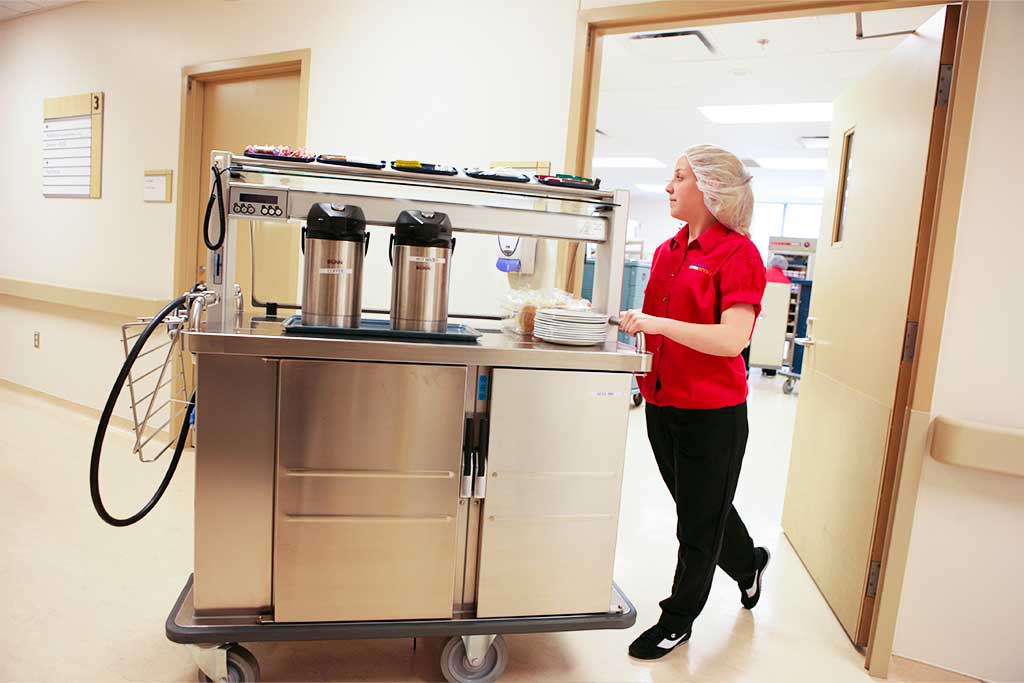
I was impressed by the B-Lean cold tray assembly process they use. Trays are assembled with chilled hot options on one side of the tray and cold items on the other before being loaded into specialised Burlodge carts. Other notes of good practice were retention food samples kept for seven days for food safety testing and ward kitchen inspections being undertaken collaboratively with clinical teams when required.
One of the most enjoyable parts of the visit was spending time with frontline staff. I shadowed Lobsang, who managed ward deliveries and service across three wards. The service was carefully staggered to allow meals to be served on the arrival of the carts and efficiently to multiple areas. I also spent time with Kia, a hardworking team member who had recently achieved registered nurse status. Her professionalism, commitment and patient-focused approach were inspiring to observe.
Beyond catering, CAMH’s commitment to staff wellbeing was striking. I visited staff welfare facilities, a modern gym, quiet reflection spaces, communal areas and learned about the use of therapy dogs and staff cooking classes. It was refreshing to see such emphasis on supporting employee wellbeing. I also learnt that staff dining facilities operate on a not-for-profit basis, with any surplus reinvested into community initiatives.
University Health Network
The final two working days were spent at the University Health Network (UHN), where I was welcomed by Laura Bernstein and her management team.
One of the most notable observations was the career pathway followed by many of the management team. Unlike the more traditional catering route often seen in the UK, many had progressed through university-based dietetics programmes before moving into patient foodservice leadership roles.
UHN comprises several specialist and acute hospitals within one large healthcare campus. During my visit, I observed the entire patient meal journey, from procurement and menu ordering to tray assembly, meal regeneration and ward service delivery.
The CBORD electronic meal ordering system was particularly impressive. The system links directly to catering management modules and supports the identification and management of dietary restrictions, therapeutic diets and allergens. Meal selections are generated from patient preferences recorded at admission. Eligible patients can access CBORD Patient app allowing them to select meals one day in advance from diet tailored choices. Diet Technicians play a key role in monitoring these requirements.
Additionally, I was shown around chilled storage facilities, dedicated stores operations, preparation areas, picking lines and pot wash facilities.
Throughout the visit, I found the entire UHN team welcoming, professional and eager to share knowledge. Their openness provided valuable insight into how large-scale healthcare foodservice operations are managed successfully in Canada.
Training and Workforce Development
There were many similarities between training in Canada and the UK.
Healthcare foodservice staff are required to undertake mandatory induction training and hold a Food Handler’s Certificate, which remains valid for five years. Most employees begin as part-time workers before progressing into permanent full-time positions as opportunities become available. Staff also complete training in organisational policies and procedures as part of their onboarding process, helping ensure consistency, compliance and safety standards are maintained.
Key Learning Points and Challenges
As with any study exchange, some of the greatest learning came from exploring both strengths and challenges.
One of the most striking observations was the comparatively lower cost of patient catering. While menu choice remained varied, many hospitals relied heavily on central suppliers and more economical ingredients to support efficiencies.
Workforce management was also highly influenced by union agreements. Overtime opportunities and additional hours are allocated according to seniority and length of service, with vacancies publicly advertised. While this undoubtedly promotes fairness and transparency, it can make shift coverage more complex and may not always support individual development opportunities.
Like many healthcare organisations worldwide, allergen management remains an ongoing challenge. Electronic safeguards provide some protection, but staff knowledge and vigilance remain essential to ensuring patient safety.
Waste management was another area that attracted attention. Although recycling and segregation of recyclable materials were well established, the volume of packaging associated with meal service was notably higher than what I am accustomed to seeing within NHS catering operations. Monitoring food waste accurately also appeared challenging.
Toronto: A City That Never Stands Still
While the purpose of my visit was professional, Toronto itself became one of the highlights of the experience.
As Canada’s largest city, Toronto is a vibrant, cosmopolitan metropolis that seems to have endless energy. From early morning until late at night, the city is constantly moving, with people from all walks of life contributing to its unique character and atmosphere. The diversity of the city was evident everywhere, reflected in its people, neighbourhoods, food, architecture and culture.
Staying in downtown Toronto allowed me to experience the city firsthand. Every walk seemed to reveal something new. Magnificent public art, sculptures and installations appeared around almost every corner, transforming streets and public spaces into open-air galleries. The city has an impressive blend of modern skyscrapers, historic buildings and green spaces, creating a skyline that is both striking and welcoming.
What impressed me most was the warmth and hospitality of the people. Whether travelling on public transport, visiting restaurants, exploring the city or meeting healthcare colleagues, everyone was friendly, approachable and proud of their city. As a visitor travelling alone, I felt at ease.
I was fortunate to visit the iconic CN Tower, one of Canada’s most recognisable landmarks. Standing high above the city provided spectacular views across Toronto and beyond, giving me a real appreciation of its scale and the vast urban landscape that stretches around Lake Ontario.
I also spent time exploring a small section of Toronto’s beautiful waterfront. The lakeside offers a welcome contrast to the bustling city centre, with open spaces, scenic views and a sense of calm that is hard to imagine whilst standing among the downtown skyscrapers. Looking out across Lake Ontario, it was easy to understand why Toronto is regarded as one of the world’s most liveable cities.
The opportunity to experience Toronto alongside the healthcare study exchange made the visit even more memorable. The city provided the perfect backdrop to a week of learning, networking and professional development, and I left with not only valuable knowledge from Canadian healthcare foodservice but also fond memories of one of North America’s most exciting and welcoming cities.
Bringing Ideas Home
As I boarded my flight home, I reflected on what had been an extraordinary week of learning, friendship and professional development.
Despite operating within different healthcare systems, healthcare caterers in Canada and the UK face many of the same challenges and share the same commitment to providing safe, nutritious and high-quality food that supports patient recovery.
I am immensely grateful to Burlodge for sponsoring the exchange and to the Hospital Caterers Association for giving me the opportunity to represent the UK internationally. My sincere thanks also go to Charles, Paul, Jo-Anna, Maria, Laura and all the teams at Burlodge Canada, CAMH and UHN for their generosity, professionalism and warm welcome.
The experience provided invaluable learning, fresh perspectives and lasting professional relationships. Most importantly, it reinforced the value of sharing ideas across international healthcare organisations and reminded me that wherever we work in the world, patient care remains at the heart of everything we do.
Pages 12-15, Hospital Caterer, Hospital Caters Association, September/October 2026
Read also

Smart Food Logistics
Alb-Fils Klinikum, a municipal hospital owned by the Göppingen district in Baden-Württemberg, elevates its patient meal service with...

A Smarter Way to Serve
Burlodge’s innovative BSmart Class-e system is supporting nutrition, ergonomics and foodservice efficiency at Centre de Rééducation...

Dish + Discourse: The Big Hospital Catering Round Table
The first hospital catering round table hosted by hospital food + service magazine took place at the end of July. Here’s what you missed....
Most read articles
Smart Food Logistics
Alb-Fils Klinikum, a municipal hospital owned by the Göppingen district in Baden-Württemberg, elevates its patient meal service with...
A Smarter Way to Serve
Burlodge’s innovative BSmart Class-e system is supporting nutrition, ergonomics and foodservice efficiency at Centre de Rééducation...
Dish + Discourse: The Big Hospital Catering Round Table
The first hospital catering round table hosted by hospital food + service magazine took place at the end of July. Here’s what you missed....